
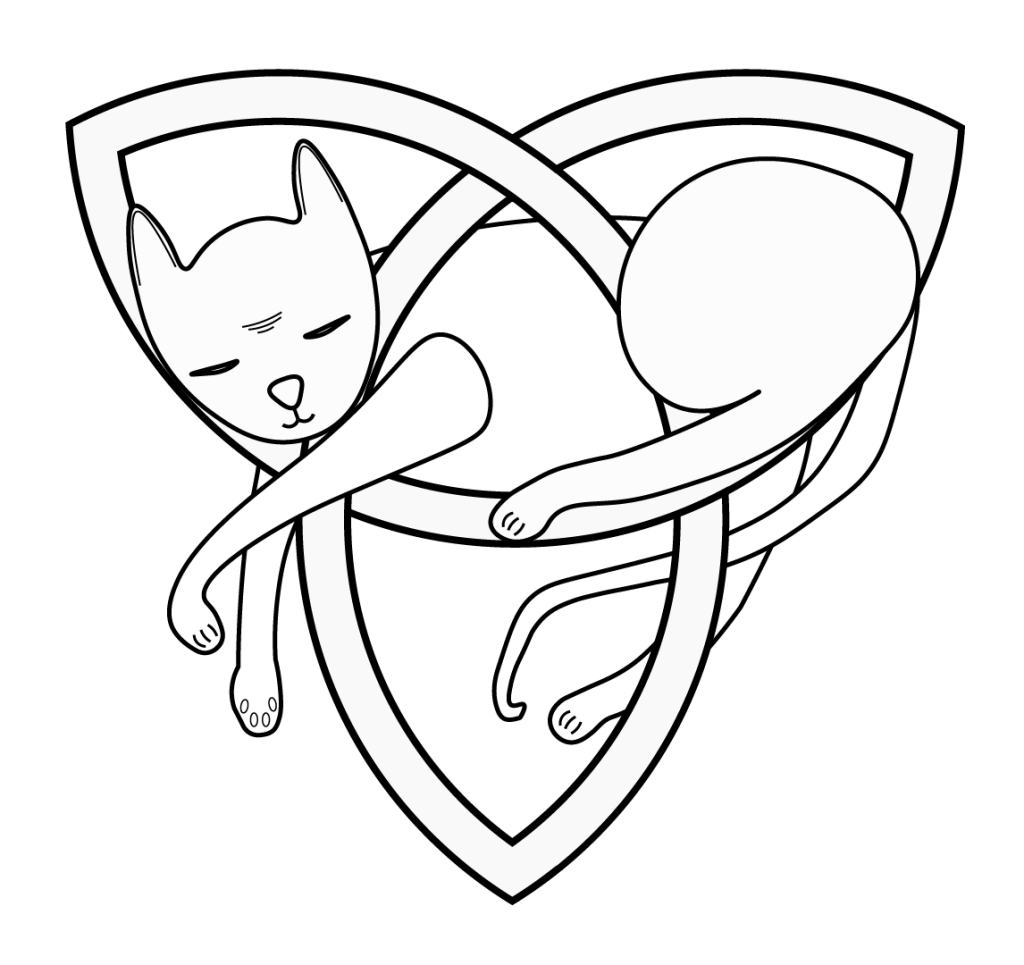
I originally designed this logo for an initiative I have yet to launch, but still hope to one day. In the interim I decided the logo I had fallen in love with was not appropriate for the initiative anyway but was perfect for me personally and so should become my personal logo for my website, like a crest or coat of arms.
The logo has two components:
A trinity knot: This Celtic knot has three intertwined loops made of one continuous line, sometimes used to represent the Christian conception of God as three in one, with the continuity of the line representing divine eternity. Christians adopted the knot from pre-Christian Celtic culture where it represented a variety of trichotomies such as life, death, rebirth; earth, sea, sky; or past, present, future. Wrestling with the idea that God is one yet somehow, mysteriously, a community has been important to my own spiritual worldview and development over the years. I’ve even preached on the topic! In my scholarship I am influenced by the American pragmatist philosopher Charles Sanders Peirce, who saw the whole world in terms of trichotomies as articulated through his triadic conception of signs and sign action (semiotics and semiosis). Unity and multiplicity ebbing and flowing betwixt one another drive the dialectic of life and thought.
A cat: But not just any cat. This cat is Pangur Bán, the white cat who is the protagonist of a 9th century poem in Old Irish by an Irish monk living at Reichenau Abbey in Germany, possibly Sedulius Scottus. The poem compares the hunting activites of the cat with the scholarly pursuits of the monk. The cat and the monk are main characters in a series of books by Fay Sampson from the 1980s, supporting characters in the 2009 animated film The Secret of Kells, and are delightfully illustrated in a 2016 childrens book by Jo Ellen Bogart and Sydney Smith, The White Cat and the Monk. The most famous translation into English is by Nobel laureate Seamus Heaney. I think of Pangur Bán as a chaplain, like me, who comes alongside and accompanies the spiritual journeys of others, all the while on my own spiritual journey. As the poem says, in Heaney’s craftful English:
So it goes. To each his own.
No vying. No vexation.
Taking pleasure, taking pains,
Kindred spirits, veterans.
I like to think of chaplaincy as this sort of accompaniment, not the chaplain leading but rather encountering others on the spiritual path, “no vying, no vexation, taking pleasure, taking pains, kindred spirits, veterans.” In the logo, Pangur Bán is not hunting but resting, as cats, and I, are wont to do, himself intertwined in the trinity knot. So may we all rest, as the psalmist says, “in the generous clasp of God, in the generous arm of God” (Psalm 121: 1).

Leave a comment